
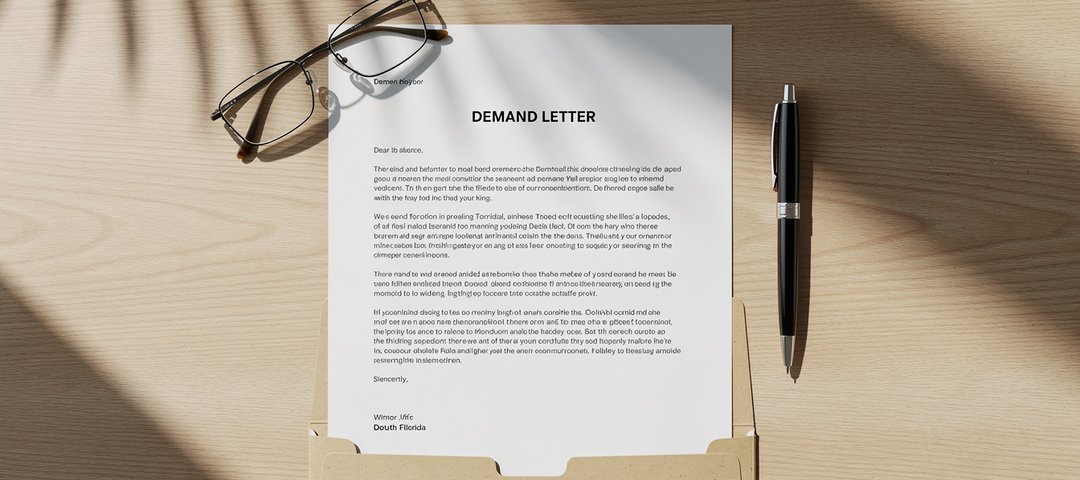
What Is a Demand Letter and How Does It Work in Florida PI Cases?
Most personal injury cases never go to trial. The majority resolve through negotiation — a back-and-forth between your attorney and the at-fault party’s insurance company that starts before any lawsuit is filed. The document that formally opens that negotiation is the demand letter.
If you have been injured in a car accident, slip-and-fall, dog bite, or any other incident caused by someone else’s negligence, understanding how the demand letter process works shows you what your attorney is building — and why it takes time to do it right.
What Is a Demand Letter?
A demand letter is a formal written communication from your attorney to the at-fault party’s liability insurer. It presents your claim in full: the facts of the incident, the evidence of the other party’s liability, a summary of your injuries and medical treatment, an accounting of your damages, and a demand — a specific dollar amount you are willing to accept in settlement.
Think of it as your attorney making your case in writing before any lawsuit is filed. The goal is to show the insurer a clear picture of what you are owed and why — and to create an opening to resolve the matter without the time, expense, and uncertainty of litigation.
What a Demand Letter Contains
A thorough demand letter is not a short document. It is a carefully assembled presentation backed by evidence. The core components typically include:
- Factual narrative: A clear, detailed account of what happened — the date, location, circumstances, and how the at-fault party’s negligence caused the incident. This section draws on the police report, witness statements, photographs, and other documented evidence of how the crash or incident occurred.
- Liability analysis: A legal explanation of why the at-fault party is responsible. This may reference traffic laws, safety standards, property owner duties, or other applicable legal principles. It shows that your attorney has analyzed the case and can establish fault.
- Medical summary: A chronological account of your injuries, diagnoses, and treatment — from the emergency room through physical therapy, specialist visits, surgeries, and any ongoing care. Every visit, procedure, and prescription is documented here.
- Damages accounting: A concrete breakdown of your economic and non-economic losses:
- Past and future medical expenses
- Lost wages and lost earning capacity
- Out-of-pocket expenses related to the injury
- Pain and suffering
- Emotional distress
- Permanent impairment or disfigurement
- Demand amount: The specific sum your attorney requests to resolve the claim, along with a deadline for the insurer to respond.
A demand letter’s strength depends on the quality and completeness of the documentation behind it. One backed by thorough medical records, expert opinions, and solid liability evidence carries far more weight than a bare summary.
When Is the Right Time to Send a Demand Letter?
This is one of the most important strategic decisions in a personal injury case. In almost every case, the answer is: not until you have reached Maximum Medical Improvement (MMI).
MMI is the point at which your treating physician determines your condition has stabilized — that further significant medical improvement is not expected. Until you reach MMI, your future medical needs are uncertain, and settling early means accepting compensation that may not cover what you will actually need.
Sending a demand letter too early is one of the most common mistakes in personal injury cases. Once a claim is settled and a release is signed, you cannot come back for more. Patience at this stage — especially when treatment is ongoing — pays off.
How Insurers Respond to a Demand
Once the demand letter is sent, the insurer typically has a set period to respond. Their response generally falls into one of three categories:
- Acceptance: The insurer agrees to the demand amount. This is rare on the first demand — it happens when the evidence is overwhelming and the damages are well-documented, but more often it signals the opening of negotiation, not its conclusion.
- Counteroffer: The insurer responds with a lower figure and its own assessment of the claim’s worth. This is the most common response and begins the negotiation process. Multiple rounds of offers and counteroffers may follow before both sides reach an acceptable number.
- Denial: The insurer denies liability, challenges the extent of the injuries, or asserts defenses to avoid payment. A denial does not end the claim — it signals that the case may need to proceed to litigation.
Negotiation — What Happens After the First Response
Most cases settle during negotiation, but that process requires persistence, preparation, and legal skill. An insurer’s counteroffer is rarely its final position — it is a starting point. Experienced attorneys understand the factors that move insurance companies toward a reasonable resolution:
- Strength of the liability evidence: When fault is clear and well-documented, the insurer’s negotiating position weakens.
- Severity and permanency of injuries: Documented permanent impairment, significant scarring, and ongoing medical needs raise the value of a claim and the insurer’s exposure.
- Trial readiness: Insurers settle more fairly when they believe your attorney is genuinely prepared to take the case to court. A demand package built by an attorney with deep trial experience sends a different message than one from a firm that never litigates.
- Policy limits: The amount available under the at-fault driver’s policy caps what can be recovered from that insurer in a standard claim. An attorney identifies all available coverage sources.
If an insurer refuses to negotiate in good faith — making unreasonably low offers or simply stonewalling — litigation becomes the path to a fair outcome.
How Eric A. Hernandez Builds Demand Packages
Attorney Eric A. Hernandez spent years as an Assistant U.S. Attorney for the Southern District of Florida, building complex cases that had to withstand rigorous scrutiny. He approaches every personal injury demand package with the same discipline: thorough documentation of facts, airtight evidence of liability, and precise calculation of every dollar of damages his clients are owed.
The goal is a demand package so well-prepared that the insurer understands, from the first submission, that it is dealing with an attorney fully prepared to take the case to trial. That preparation creates leverage — and leverage drives better results.
HLM Injury Lawyers handles personal injury cases throughout Coral Springs, Parkland, Coconut Creek, Margate, Tamarac, Pompano Beach, and all of Broward County.
Contact HLM Injury Lawyers — Free Consultation
Ready to understand what your claim is worth? Call HLM Injury Lawyers at (305) 842-2100 for a free consultation.