
Road Rage Accidents in Broward County: Legal Options for Victims
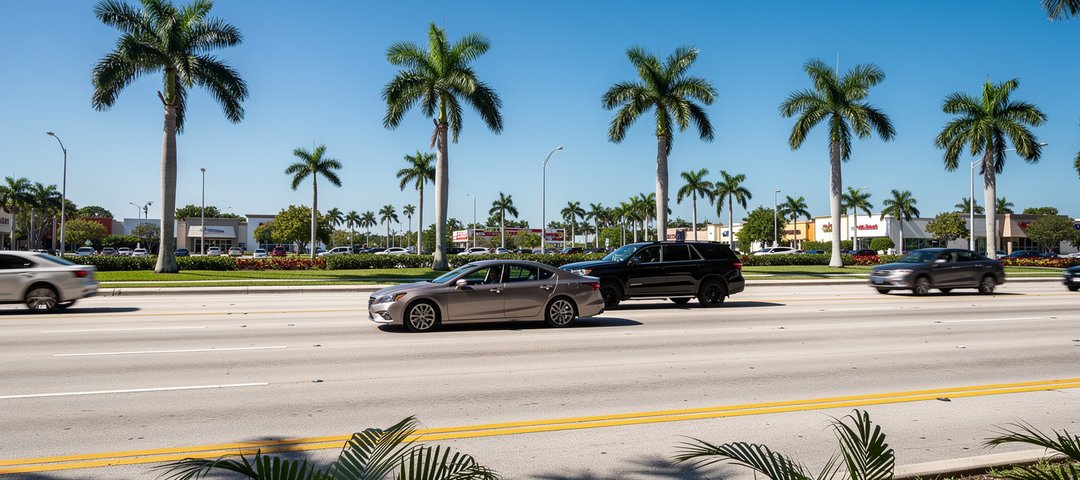
South Florida’s roads are among the most heavily trafficked in the country, and Broward County is no exception. High traffic volume, intense heat, and a driving culture that rewards aggression have made road rage a serious public safety problem. If you have been injured by an aggressive driver — through a deliberate collision, a forced lane change, or an assault after a roadway confrontation — you have legal options. This guide explains how road rage accidents differ from ordinary car accidents and what you can do to protect yourself.
The Rise of Aggressive Driving in South Florida
Aggressive driving incidents — tailgating, excessive speeding, deliberate blocking, retaliatory braking, and outright intentional collisions — have increased across South Florida in recent years. Broward County’s major corridors, including I-95, the Turnpike, US-441, Sample Road, and Commercial Boulevard, are frequent scenes of confrontations between drivers.
Road rage is not just reckless driving. It describes a pattern of intentional, aggressive behavior by a driver who directs hostility at another vehicle or person. The distinction between ordinary negligence and intentional conduct matters significantly in the legal context.
Two Paths to Legal Recovery — Negligence and Intentional Torts
Most car accident claims are built on negligence — the failure to exercise reasonable care, which causes injury to another person. But road rage cases can support a second, distinct legal theory: intentional tort.
Negligence claims apply even in road rage cases. A driver who follows too closely, cuts off another vehicle, or causes a collision through aggressive but arguably unintentional driving behavior is still liable for negligence. The standard elements apply: the driver owed you a duty of care, breached that duty, and caused your injuries and damages.
Intentional tort claims arise when the conduct crosses from reckless to deliberate. If a driver intentionally rams your vehicle, runs you off the road, or assaults you after a roadway confrontation, you can bring claims for assault, battery, or intentional infliction of emotional distress — in addition to negligence.
This distinction goes beyond legal theory. Intentional tort claims may support punitive damages — damages designed not to compensate you, but to punish the defendant and deter similar conduct. Punitive damages are available in appropriate cases involving intentional or particularly egregious conduct, and their availability and scope depend on the specific facts of each case.
The Insurance Coverage Complication
Here is a reality that surprises many road rage victims: standard auto insurance policies often exclude intentional acts. If you pursue an intentional tort theory against a road rage driver, their liability insurer may deny coverage on the grounds that the conduct was not an “accident” under the policy.
This complication does not eliminate your right to recover — but it changes the practical landscape:
- The at-fault driver’s personal assets may be the source of recovery if their insurer denies the intentional acts claim.
- Your own uninsured/underinsured motorist (UM/UIM) coverage may provide a recovery path, since your own policy covers you regardless of whether the other driver’s insurer pays.
- Negligence theories are typically covered, so structuring claims to include both theories — negligence and intentional conduct — may preserve insurance coverage while still allowing pursuit of punitive damages.
Sorting through this coverage puzzle requires an attorney who understands both personal injury law and insurance coverage disputes. Eric A. Hernandez’s background — including his experience as a former Assistant U.S. Attorney for the Southern District of Florida — gives him a thorough understanding of how insurance coverage disputes play out in litigation.
What to Do If You Are Targeted by an Aggressive Driver
If you find yourself the target of a road rage driver, safety comes first. Then documentation.
- In the moment
- Do not engage or retaliate. Engaging an aggressive driver escalates the risk of violence.
- Do not pull over in an isolated location. If you believe you are being followed, drive to a police station, fire station, or busy public area.
- Call 911 and report the aggressive driver’s license plate, vehicle description, and direction of travel.
- If you are forced to stop and a confrontation occurs, stay in your vehicle with the doors locked if possible.
- After the incident
- Get a police report. This is especially important in road rage cases because it creates a contemporaneous record of the incident and the aggressive driver’s identity.
- Seek medical attention. Even if you do not feel seriously injured, adrenaline can mask pain. Delayed onset injuries — whiplash, concussion, soft tissue damage — are common after crash events.
- Document the scene. Photographs of vehicle damage, your injuries, the location, any debris on the road, and any witnesses present.
- Preserve dashcam footage. If you have a dashcam, do not allow the footage to overwrite. Download and save it immediately.
- Write down your account. Memory fades. Write out exactly what happened, including the other driver’s behavior, the sequence of events, and what was said or done.
Criminal Charges and Civil Claims — Two Separate Tracks
In serious road rage incidents, the aggressive driver may face criminal prosecution. A criminal conviction can be powerful supporting evidence in a civil case — but the two proceedings are legally independent.
You do not need to wait for criminal charges to be filed or resolved before pursuing a civil claim. Nor does a criminal acquittal prevent you from recovering civil damages. The standards of proof are different: a criminal case requires proof beyond a reasonable doubt; a civil case requires a preponderance of the evidence.
However, the facts and evidence developed in a criminal investigation — witness statements, police reports, video evidence, the defendant’s admissions — can be highly valuable to your civil case. Getting an attorney involved early helps ensure that evidence is identified and preserved.
The Two-Year Statute of Limitations
Florida’s statute of limitations for personal injury claims, including road rage incidents, is two years from the date of the accident. Do not allow a lengthy criminal proceeding to distract you from this civil deadline. Your attorney can pursue your civil claim while the criminal process proceeds separately.
Contact HLM Injury Lawyers — Free Consultation
Road rage incidents are traumatic, and the legal questions they raise are more complex than a standard car accident claim. If you were injured by an aggressive driver in Broward County or anywhere in South Florida, Eric A. Hernandez at HLM Injury Lawyers is ready to fight for you. Call (305) 842-2100 to schedule your free consultation. Our office is located at 3301 N. University Dr., Suite 100, Coral Springs, FL 33065. No fee unless we win.