
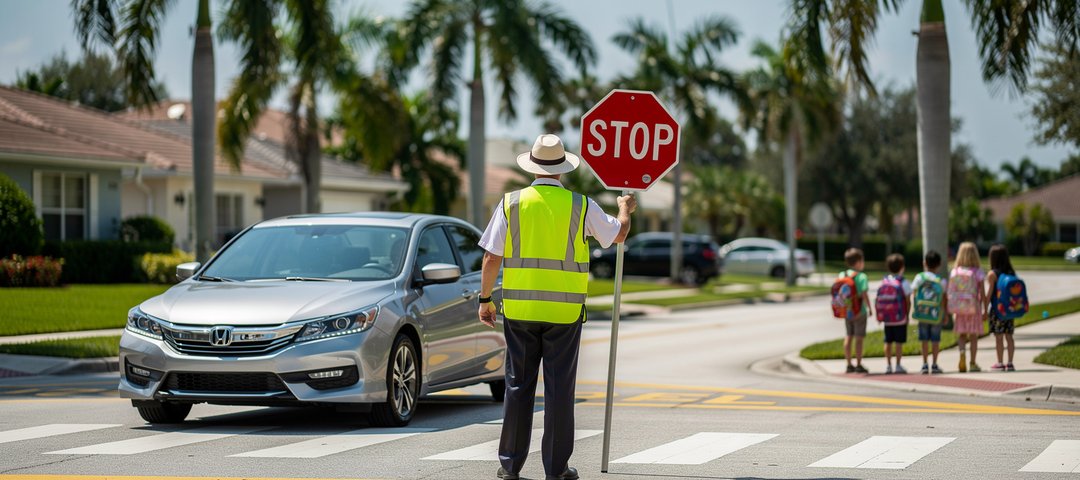
Back-to-School Traffic Safety: Protecting Kids in Coral Springs
Every August, the streets around Coral Springs schools transform. Pickup lines stretch around blocks, crosswalks fill with children in backpacks, and bus stops reappear on neighborhood corners. It is one of the most predictable traffic events of the year — and yet, school zones remain some of the most dangerous places for children in South Florida. If your family has been affected by a traffic accident near a school, you need to understand your rights. And if your child has been injured, you need to act quickly.
The Danger of School Zone Traffic
The concentration of vehicles, pedestrians, buses, and bicyclists at arrival and dismissal times creates conditions where accidents happen. Children are unpredictable — they dart between cars, cross outside of crosswalks, and may not have the developmental maturity to judge traffic speeds or distances.
Common accident types in school zones include:
- Pedestrian knockdowns at crosswalks or along sidewalks, often involving distracted drivers who fail to yield
- Bus-related accidents: children struck while crossing in front of or behind a bus, or injured while boarding or exiting
- Rear-end collisions in pickup and drop-off lines where drivers are distracted by phones
- Bicycle accidents near schools where children ride to school and cross active traffic lanes
Coral Springs is home to numerous schools — elementary, middle, and high schools — and the surrounding neighborhoods of Parkland, Coconut Creek, Margate, and Tamarac face similar conditions each school year.
Driver Duties in School Zones
Drivers passing through school zones have heightened legal duties. Florida law mandates reduced speed limits in school zones during designated hours, and fines for violations in school zones are increased. A driver who strikes a child in a school zone — through distraction, excessive speed, failure to yield, or running a stop sign — will almost certainly be found negligent.
Beyond school zones, Florida law governs how drivers must interact with school buses:
- Drivers must stop when a school bus displays its stop signal and extends its stop arm.
- This requirement applies in both directions on undivided roads.
- Violations carry significant penalties — and when a child is struck because a driver failed to stop for a school bus, that failure is strong evidence of negligence.
Distracted driving — particularly phone use — is a leading cause of accidents in school zones. A driver who is looking at their phone rather than the road has failed to exercise the basic duty of care owed to children in school zones.
Bus Safety — What Families Should Know
School buses are, statistically, among the safest ways for children to travel. But accidents do happen, and they can be severe. Bus-related injuries involving children may occur:
- During loading and unloading: the most dangerous phase. Children struck while crossing in front of a bus are often killed or seriously injured.
- Inside the bus during a crash or sudden stop — injuries to unrestrained passengers.
- From bus driver negligence: inattention, improper stops, or failure to verify all children have safely exited.
Liability for bus accidents depends on who operates the bus. If the bus is operated by a school district, claims may involve a government entity. If operated by a private contractor, different rules apply.
Claims Against Government Entities — Act Faster
If a child is injured at a school zone, on school grounds, or by a school district vehicle, the at-fault party may be a government entity — a municipality, school board, or county. This creates an important legal complication.
Claims against government entities in Florida have shorter notice requirements than standard personal injury claims. Before you can file a lawsuit against a government entity, you may be required to file a formal notice of claim within a specific period. The standard two-year personal injury statute of limitations does not give you the full two years to present your initial notice — the notice deadline may be significantly shorter.
This is one of the most critical reasons to contact an attorney immediately after a school zone accident involving a government entity or school bus. Missing the notice deadline can permanently bar your claim — regardless of how serious your child’s injuries are.
What to Do If Your Child Is Injured
If your child is involved in a traffic accident near school, on a bus, or in a school zone, take these steps:
- Seek medical care immediately. Even if your child seems fine, children may not be able to accurately report all symptoms. A medical evaluation documents the injuries.
- Request a police report and a school incident report. Both create contemporaneous records.
- Preserve evidence. Photographs of the scene, vehicle damage, and any visible injuries. Ask about any available dashcam or security camera footage.
- Do not speak with insurance adjusters: whether the school district’s insurer, the driver’s insurer, or your own — without first consulting an attorney.
- Contact an attorney right away. Given the potential for government entity involvement and shorter notice deadlines, time is especially critical.
Compassionate Representation for Coral Springs Families
Eric A. Hernandez has represented families throughout Coral Springs, Parkland, and Broward County for over 25 years. He understands the urgency of school-related injury cases — particularly when government entities are involved — and he moves quickly to preserve evidence and protect legal rights.
When a child is injured, nothing is more important than getting answers, accessing quality medical care, and ensuring that the responsible parties are held accountable. HLM Injury Lawyers handles these cases with the urgency and compassion they deserve.
Contact HLM Injury Lawyers — Free Consultation
If your child was injured in a school zone accident, bus accident, or any traffic incident near school in Coral Springs or Broward County, contact HLM Injury Lawyers right away. Call Eric A. Hernandez at (305) 842-2100 for a free consultation. Our office is at 3301 N. University Dr., Suite 100, Coral Springs, FL 33065. Time matters — do not wait.