What Documents Do I Need for My Personal Injury Case? (Complete Checklist)
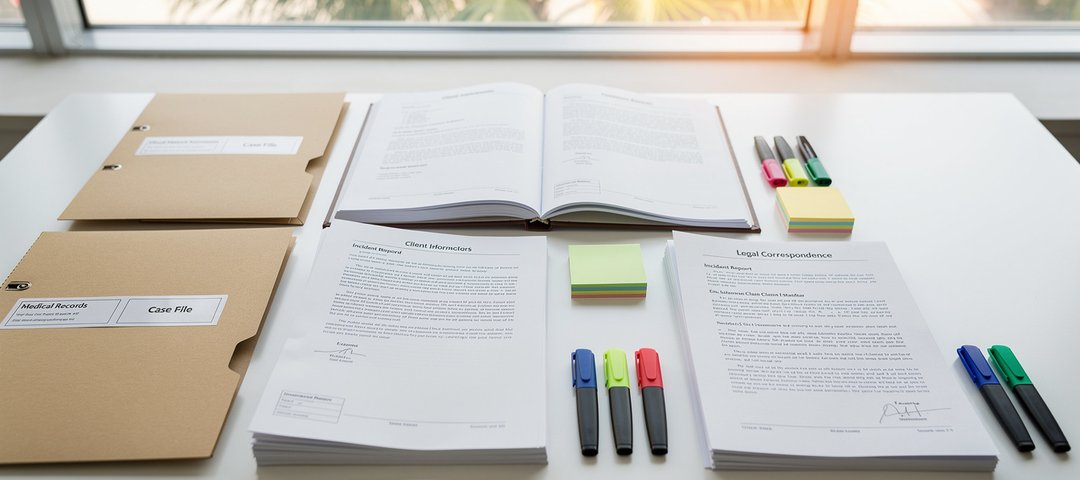
One of the most important things you can do after an accident is start gathering documents. Evidence fades, memories shift, and records get harder to obtain over time. Whether you were injured in a car accident, a slip and fall, or any other incident caused by someone else’s negligence, having the right paperwork organized and preserved gives your attorney the foundation to build a strong claim. This checklist covers every key document you will need — and explains why each one matters.
1. Police Report or Accident Report
- What it is: The official report generated by law enforcement who responded to the scene.
- Why it matters: The police report establishes the basic facts of the accident — date, time, location, vehicles involved, and the officer’s preliminary assessment of fault. It often includes witness names and contact information and may note whether any citations were issued. Insurance adjusters and attorneys rely on this document heavily in the early stages of a claim.
- How to get it: In Broward County, you can typically request a crash report from the Florida Department of Highway Safety and Motor Vehicles or from the responding law enforcement agency. There is usually a small fee and a brief waiting period before the report is available.
2. Medical Records and Bills
- What they are: All records from every medical provider who treated you following the accident — emergency rooms, urgent care centers, hospitals, orthopedic surgeons, neurologists, physical therapists, chiropractors, and mental health professionals.
- Why they matter: Medical records are the documentary bridge between the accident and your injuries. They establish what injuries you sustained, when you first sought treatment, what your providers found, and what they recommend for your recovery. Bills establish the economic damages you have incurred. Gaps in treatment — periods where you did not seek care — let the insurance company argue your injuries were not serious or were caused by something other than the accident.
- Practical tip: Request records promptly and continue requesting updated records throughout your treatment. Gaps and delays in your record collection create problems later.
3. Photographs of Your Injuries and the Accident Scene
- What they are: Images documenting your physical injuries as well as the scene of the accident.
- Why they matter: A photograph of a bruised face, a lacerated arm, or a surgical scar tells a story that words alone cannot. Scene photographs — the damaged vehicles, the defective stairway, the wet floor with no warning sign — establish the physical reality of what happened. Insurance companies are skilled at minimizing claims in the abstract; photographs make minimization harder.
- Practical tip: Photograph your injuries on the day of the accident and continue documenting their progression over the following days and weeks. Bruises and swelling often look worse on days two and three. If you did not photograph the scene immediately, see if surveillance footage, dashcam footage, or other documentary evidence exists.
4. Insurance Policies
- What they are: Your own auto insurance policy, homeowner’s or renter’s policy if relevant, and any insurance information you obtained from the at-fault party.
- Why they matter: Your own policy dictates what Personal Injury Protection (PIP) benefits are available — Florida requires a minimum of $10,000 in PIP coverage, and treatment must begin within 14 days of the accident to qualify. Your policy also determines whether you carry uninsured/underinsured motorist (UM/UIM) coverage, which can be critical if the at-fault driver lacks adequate coverage. The at-fault party’s policy establishes the limits against which you are claiming.
- Practical tip: Pull your full policy declaration page, not just your insurance card. The declarations page shows your actual coverage limits and what endorsements apply.
5. Witness Contact Information
- What it is: Names, phone numbers, and email addresses for anyone who witnessed the accident or its immediate aftermath.
- Why it matters: Independent witness testimony can be decisive in disputed liability cases. The at-fault party and their insurer will present their version of events. Witnesses who have no stake in the outcome carry significant weight with adjusters, mediators, and juries. Bystander accounts fade quickly — people move, forget details, and become harder to locate as time passes.
- Practical tip: Collect witness information at the scene if you are physically able. If you cannot, ask a bystander, a family member, or a first responder to do it for you.
6. Lost Wage Documentation
- What it is: Evidence of income lost because of your injuries — pay stubs, W-2 forms, tax returns, an employer letter confirming your regular wages and the time you missed, and any documentation of self-employment income.
- Why it matters: Lost wages are economic damages that you are entitled to recover. But you must be able to prove them with specificity. Vague claims that you “lost some work” are easy to dispute. A letter from your employer confirming your hourly rate or salary, the number of days you missed, and the total amount of lost pay is far more persuasive.
- Practical tip: If you are self-employed, gather contracts, invoices, and tax returns that establish your income history. A CPA or financial expert may be needed to project future earning losses for serious, long-term injuries.
7. Communications with Insurance Companies
- What it is: Every letter, email, text, or voicemail exchanged between you and any insurance company — your own and the at-fault party’s insurer.
- Why it matters: What you say to an insurance company — and what they say to you — can affect your claim in ways you may not anticipate. Recorded statements, written denials, delay letters, and low settlement offers are all part of the claims record. Preserving these communications lets your attorney respond to insurer arguments and hold insurers accountable for what they have said and promised.
- Practical tip: Do not give a recorded statement to the at-fault driver’s insurer without first speaking to an attorney. You have no obligation to do so.
8. Symptom Journal
- What it is: A personal daily log that you keep from the time of the accident forward, documenting your symptoms, pain levels, limitations, and how the injury affects your daily life.
- Why it matters: Non-economic damages — pain and suffering, loss of enjoyment of life, emotional distress — are subjective by nature. A contemporaneous journal written in your own words, day by day, is among the most powerful evidence of what you actually experienced. It is far more credible than a retroactive account reconstructed months later under an attorney’s guidance.
- Practical tip: Write in plain, honest language. Note what you could not do because of your injuries — the children’s soccer game you missed, the project at work you struggled to complete, the nights you could not sleep. Specificity and consistency matter.
How an Attorney Helps Gather and Preserve Evidence
Even with this checklist, assembling evidence after an accident is harder than it sounds. Medical records requests can be slow and incomplete. Police reports contain errors that need to be addressed. Surveillance footage from a business near the accident scene may be overwritten within 30 to 60 days if no one sends a preservation letter promptly.
An experienced attorney does more than organize documents you hand over — they proactively identify and preserve evidence before it disappears. Attorney Eric A. Hernandez and the team at HLM Injury Lawyers send timely preservation demands, subpoena records, engage accident reconstruction experts when needed, and build the complete evidentiary picture your claim requires.
Contact HLM Injury Lawyers — Free Consultation
If you were injured in an accident in Coral Springs, Parkland, Coconut Creek, or anywhere in Broward County, do not wait to start preserving your evidence. Contact HLM Injury Lawyers at (305) 842-2100 for a free consultation. Attorney Eric A. Hernandez — a former Assistant U.S. Attorney with over 25 years of trial experience — will evaluate your case and help you take the right steps from day one. There is no fee unless we recover for you.