Slip and Fall at a Florida Grocery Store: Who Pays?
Grocery stores are among the most common locations for slip and fall accidents in Florida. The combination of hard floors, refrigerated display cases that produce condensation, liquid spills from broken containers, and high foot traffic creates conditions where a hazardous surface can appear suddenly and persist for longer than it should. When someone slips on a wet floor, falls on a slippery substance, or trips on a hazard that should have been addressed, the consequences can be serious — broken bones, torn ligaments, traumatic brain injuries, and spinal injuries are all documented outcomes of falls in retail settings.
But falling in a grocery store does not automatically mean the store is liable for your injuries. Florida premises liability law requires you to prove what the store knew — or should have known — about the hazard that caused your fall. HB 837 significantly updated that standard in 2023, and understanding it is essential before you pursue a claim.
This post explains the legal framework for grocery store slip and fall claims in Florida, what evidence you need to gather immediately after the incident, and how an attorney protects your ability to pursue those claims in the time-sensitive period following a fall.
Florida’s Transitory Foreign Substance Standard
HB 837 codified Florida’s approach to slip and fall claims involving transitory foreign substances — meaning liquids, foods, or other materials on a floor that are not supposed to be there. Under this standard, to hold a business liable for a slip and fall caused by a transitory substance, you must prove that the business had actual or constructive knowledge of the dangerous condition and failed to take corrective action.
This is the legal standard that distinguishes a valid premises liability claim from an unfortunate accident. Not every fall in a store creates legal liability. The key is what the store knew — or should have known — about the hazard.
- Actual knowledge: The store (through its employees or management) knew the hazard existed. This could be shown by an employee who walked past a spill and did not clean it up, a customer complaint about the hazard that was not acted on, or store surveillance showing that the spill was visible to staff.
- Constructive knowledge: The store should have known about the hazard because it existed for a long enough period that a reasonable inspection would have discovered it, or because the condition occurred regularly and the store was therefore on notice of the recurring risk.
The constructive knowledge standard involves a judgment call about what a “reasonable” inspection interval looks like for the specific store and the specific area where the fall occurred. High-traffic areas with frequent spill risk — produce sections, refrigerated aisles, checkout lanes — may require more frequent inspection than dry goods aisles. An attorney can analyze the store’s inspection records, cleaning logs, and standard operating procedures to build the constructive knowledge argument.
Evidence to Gather at the Scene
The moments immediately after a slip and fall are critical for preserving evidence. If you can do so safely, gather the following before leaving the store.
- Report the incident: Find a manager and report the fall before you leave. Request that an incident report be completed and ask for a copy. This document creates an official record that a fall occurred on the store’s premises on a specific date and time. If the store refuses to provide a copy, note the name of the manager you spoke with.
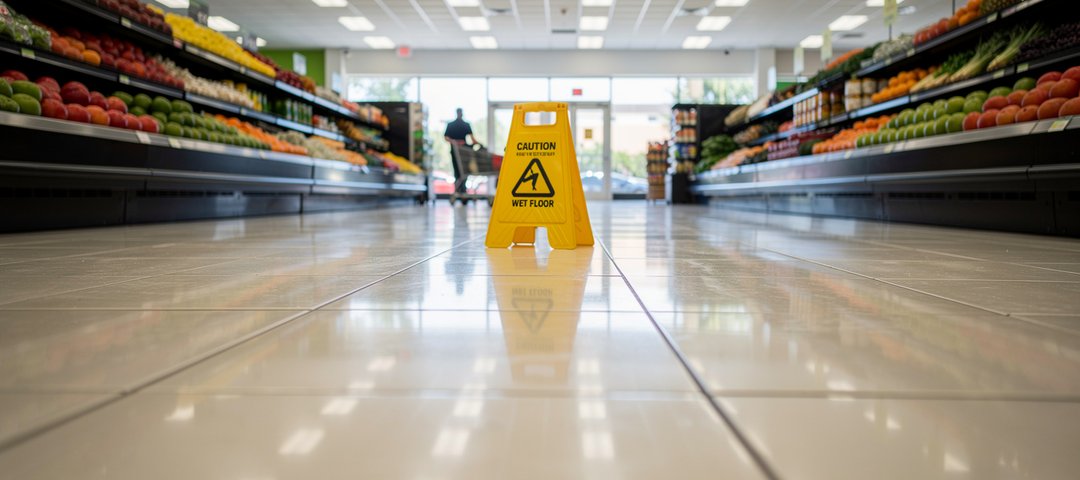
- Photograph the hazard: Use your phone to photograph the substance or condition that caused your fall — the liquid, food, or debris on the floor, the extent of the wet area, the absence or presence of warning signs. Also photograph the surrounding area, floor markings, and any wet-floor cones (or the absence of them).
- Photograph your injuries: Visible injuries — bruising, abrasions, swelling — should be photographed at the scene and again over the following days as they develop.
- Identify witnesses: Anyone who saw the fall, who walked past the hazard before the fall, or who is aware of how long the condition existed could be a crucial witness. Get names and phone numbers.
- Note your footwear: The condition and type of shoes you were wearing may be raised by the store as a comparative fault issue. Preserve the shoes you were wearing.
- Do not clean up: Do not help clean up the substance before it has been photographed and documented. Once the floor is cleaned, the hazard is gone.
Why Surveillance Footage Must Be Preserved Quickly
Most modern grocery stores have comprehensive surveillance camera systems covering their sales floors. That footage may show exactly how long the hazardous condition existed before your fall — which is directly relevant to the constructive knowledge analysis. It may also show whether any store employee walked past the area, whether warning signs were placed or removed, and the precise circumstances of the fall itself.
The problem is that surveillance footage is typically overwritten on a rolling basis — often within 24 to 72 hours. Once overwritten, it is gone. No attorney can recover footage that no longer exists.
An attorney who is retained promptly can send a legal preservation letter to the store demanding that the relevant footage be preserved. This letter creates a legal obligation to retain the footage and protects against the possibility that the store allows it to be overwritten. Some stores will preserve footage voluntarily; others must be compelled.
This is one of the most time-sensitive actions in a slip and fall case — and one of the strongest arguments for contacting an attorney as soon as possible after a fall.
What Damages Are Available in a Florida Slip and Fall Claim
If you can establish the store’s actual or constructive knowledge of the hazard, you may be entitled to recover the same categories of damages available in other Florida personal injury claims.
- Medical expenses: Emergency room care, diagnostic imaging, surgery, physical therapy, and any ongoing treatment necessitated by your injuries.
- Lost wages: Time missed from work during recovery.
- Future medical costs: If your injuries require ongoing treatment or have lasting effects.
- Pain and suffering: Compensation for physical pain, discomfort, and the emotional toll of the injury.
- Loss of enjoyment of life: If your injuries limit your ability to participate in activities that were part of your life before the fall.
Florida’s 2-Year Statute of Limitations
Under HB 837, Florida’s statute of limitations for premises liability claims — including grocery store slip and falls — is two years from the date of the incident. Missing this deadline forfeits your right to pursue the claim entirely, regardless of how severe your injuries are or how clear the store’s negligence may be.
Two years moves quickly, particularly when medical treatment is ongoing and the claims process is just beginning. An attorney can manage the legal timeline while you focus on recovery.
Comparative Negligence in Slip and Fall Cases
Florida’s modified comparative negligence rule applies to premises liability claims, including grocery store falls. If a store argues that you contributed to your own fall — by wearing inappropriate footwear, by walking in an area marked as closed, or by failing to observe obvious warning signs — your recovery may be reduced by your percentage of fault. If your fault reaches 51% or more, you recover nothing.
Stores and their insurers routinely raise comparative fault arguments in slip and fall cases. They may claim that a wet floor sign was visible and you ignored it, that your footwear was unsuitable for wet floors, or that the hazard was open and obvious. Each of these arguments requires specific counter-evidence — and the evidence you gather at the scene is what allows your attorney to challenge them effectively.
Documenting the absence of wet floor signs, photographing the exact condition of the floor and the surrounding area, and identifying witnesses who can confirm the hazard was not adequately marked are all steps that directly address potential comparative fault arguments before they are made.
Contact HLM Injury Lawyers — Free Consultation
If you were injured in a slip and fall at a Florida grocery store or other retail location, HLM Injury Lawyers can help you understand whether you have a valid claim and how to pursue it. The evidence preservation window is short — the sooner you call, the better positioned you are. HLM Injury Lawyers offers free consultations. Call (305) 842-2100.