
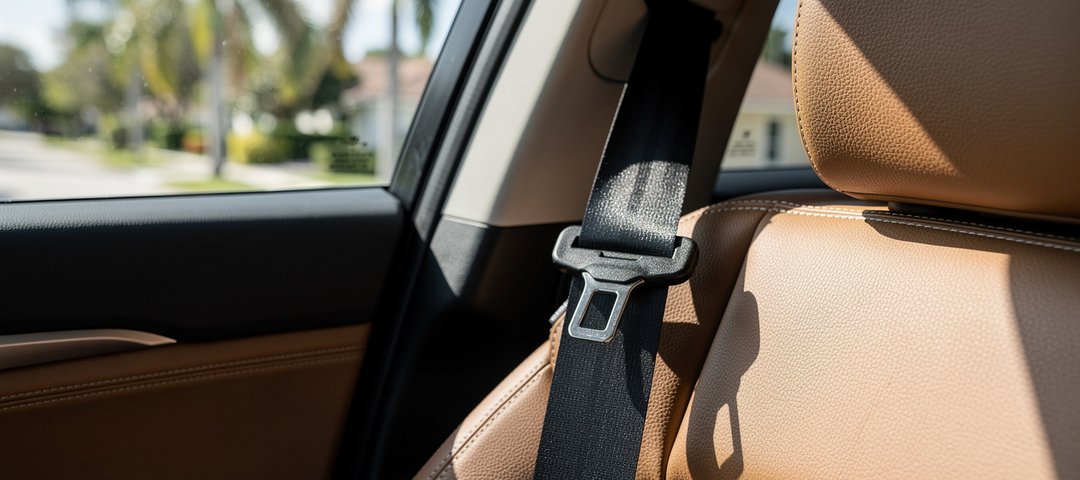
Can I Still File a Claim If I Wasn’t Wearing a Seatbelt?
Many people who were not wearing a seatbelt at the time of a car accident assume they have no case — or that they will be blamed entirely for their own injuries. This is not accurate. In Florida, not wearing a seatbelt does not eliminate your right to file a personal injury claim. It may affect certain aspects of your recovery, but it does not close the door. If you were injured in an accident caused by someone else, you deserve to understand your full legal options — regardless of whether you were buckled up.
Florida’s Seatbelt Evidence Rule
Florida has a specific rule governing how evidence of seatbelt non-use can be used in personal injury cases. Under this rule, evidence that you were not wearing a seatbelt is admissible — meaning the other side can introduce it. However, Florida limits the purpose for which that evidence can be used and places restrictions on its effect on your overall recovery.
The general principle is that seatbelt non-use evidence goes to the damages portion of the case — specifically to the question of whether your injuries would have been less severe had you been wearing a seatbelt. It does not go to the question of who caused the accident.
This is an important distinction. The driver who ran a red light, rear-ended your vehicle, or drove drunk is still the cause of the accident. Your choice not to wear a seatbelt did not cause the crash — it may only be relevant to the question of whether it contributed to the severity of your injuries.
Comparative Negligence Still Applies
Florida’s modified comparative negligence law applies to all personal injury cases, including those where seatbelt non-use is at issue. Under this framework, your total recovery can be reduced in proportion to your share of fault.
The critical threshold: if you are found 51% or more at fault for your own injuries, you cannot recover anything. But — and this matters — seatbelt non-use is weighed in the context of damages, not as the primary cause of the accident itself. A driver who caused the crash through recklessness does not escape accountability simply because you were not belted.
The comparative negligence analysis in seatbelt cases is fact-specific. The defense will argue that had you been wearing a seatbelt, your specific injuries would not have occurred or would have been less severe. Your attorney’s job is to challenge those arguments with medical evidence and expert testimony.
The Accident Cause vs. Injury Severity Distinction
Here is the legal logic that protects seatbelt non-users from losing their entire claim:
Courts separate two questions. First: what caused the accident? Second: what caused or worsened the injuries?
The first question — causation of the accident — is entirely about the at-fault driver’s conduct. Your seatbelt use is irrelevant to that analysis.
The second question — extent of injuries — is where seatbelt evidence becomes relevant. The argument is that wearing a seatbelt might have reduced the severity of your injuries. But this argument must be supported by evidence. It is not automatic. The defense must produce proof — typically through medical experts — that a seatbelt would have meaningfully reduced your specific injuries given the specific nature of the crash.
Many crashes involve injuries where seatbelt use would not have significantly changed the outcome. High-speed collisions, side-impact crashes, and rollovers often produce severe injuries regardless of seatbelt use. Your attorney can retain the experts needed to challenge seatbelt-based damage reduction arguments.
Why Fear of Seatbelt Issues Should Not Stop You From Consulting an Attorney
One of the most costly mistakes an injured person can make is to assume they have no case because of some perceived fault on their part — and never consult an attorney. That assumption costs injured people real money.
Consider what you may be walking away from:
- Medical bills that can run into tens of thousands of dollars or more
- Lost wages from time missed at work
- Compensation for pain and suffering
- Future medical care if your injuries are long-term
Even if seatbelt non-use reduces your recovery by some percentage, that reduced recovery may still be far greater than nothing. And in many cases, the seatbelt argument proves weaker than the defense hopes — because medicine often cannot establish a clear causal link between belt non-use and specific injuries in specific crash dynamics.
The only way to know where your case truly stands is to have it evaluated by an experienced personal injury attorney.
Insurance Company Strategy — The Seatbelt Argument
Insurance adjusters know about the seatbelt evidence rule, and they use it strategically. When they learn you were not wearing a seatbelt, expect them to:
- Immediately emphasize the seatbelt issue in early conversations
- Offer reduced settlements justified by alleged seatbelt-related fault
- Obtain medical opinions supporting the claim that your injuries were caused or worsened by belt non-use
Do not let these tactics go unchallenged. An insurer’s initial assessment of how the seatbelt issue affects your case is not a neutral legal analysis — it is a negotiating position. Having your own attorney evaluate and challenge that position changes the dynamic entirely.
Other Factors That Affect Recovery When You Were Unbelted
Even in cases where seatbelt non-use is an issue, the overall recovery analysis involves many other factors:
- The severity of the at-fault driver’s conduct: A drunk driver or someone who ran a stop sign carries significant fault that may far outweigh the seatbelt issue.
- The nature of your injuries: Some injury types are less susceptible to a seatbelt-causation argument.
- Available insurance coverage: The at-fault driver’s policy limits and your own underinsured motorist coverage affect the practical value of your claim.
- Other contributing factors: If the at-fault vehicle was defective, or if road conditions created an additional hazard, multiple liability theories may apply.
A thorough case evaluation by an experienced attorney considers all of these variables — not just the seatbelt question in isolation.
The Two-Year Statute of Limitations Still Applies
Whatever the facts of your case — including seatbelt non-use — the two-year statute of limitations for personal injury claims in Florida still applies. The clock runs from the date of the accident. Do not delay consulting with an attorney because you believe the seatbelt issue kills your case. Let an attorney evaluate the full picture.
Contact HLM Injury Lawyers — Free Consultation
If you were not wearing a seatbelt and are unsure whether you have a case, the answer is: you may have more options than you think. Eric A. Hernández at HLM Injury Lawyers will give you an honest, thorough evaluation at no charge. Call (305) 842-2100 to schedule your free consultation. Our office is at 3301 N. University Dr., Suite 100, Coral Springs, FL 33065. You owe it to yourself to find out where you stand.